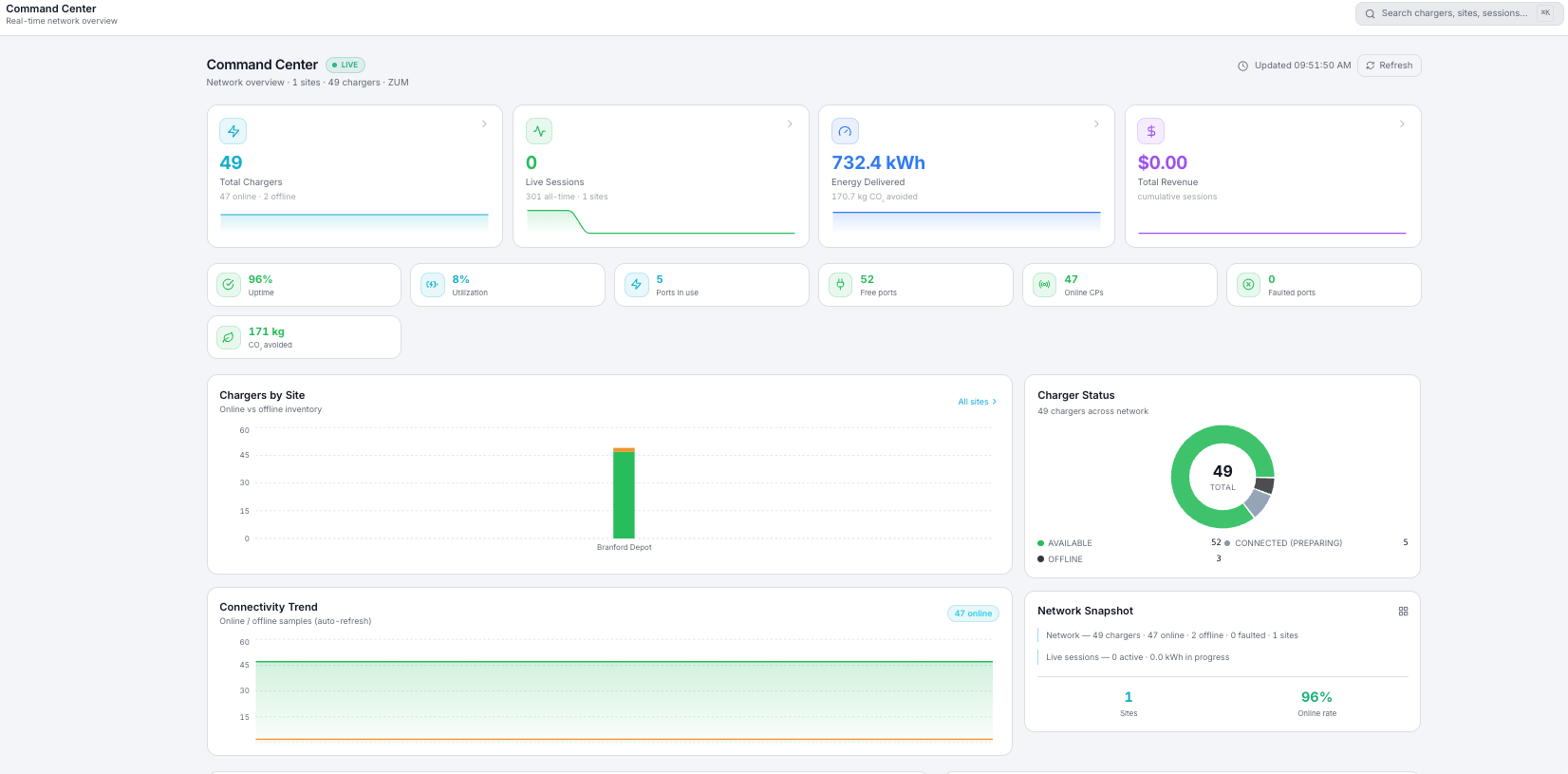
GravOS Charge is an operations platform and a growth partner. We work with you to raise utilization, cut the cost of every kWh, and open new revenue — including turning parked vehicles into grid assets with bidirectional V2G and V2X.
You’ve already spent the capital on hardware, civils and grid connection. The only question that matters now is how hard each stall works — and what it costs you to keep it working.
See utilization by site, by stall, by hour and by day — then act on it. Identify dead hours, underperforming locations and queuing hotspots, and fix pricing or capacity accordingly.
Faults surface in minutes, and many resolve remotely. A driver who finds a broken charger rarely comes back — uptime is a retention metric, not just an ops metric.
Load balancing and tariff-aware scheduling hold your peak down, so demand charges stop eating the margin on every session you sell.
Dynamic capacity sharing lets you put more chargers behind the same connection — deferring upgrades and interconnection queues that stall expansion.
Grid services, demand response and roaming turn your estate into more than a retail business. Revenue that doesn’t depend on a driver plugging in.
Time-of-use and demand-aware pricing that reflects what power actually costs you at that moment, protecting margin at peak and driving volume off-peak.
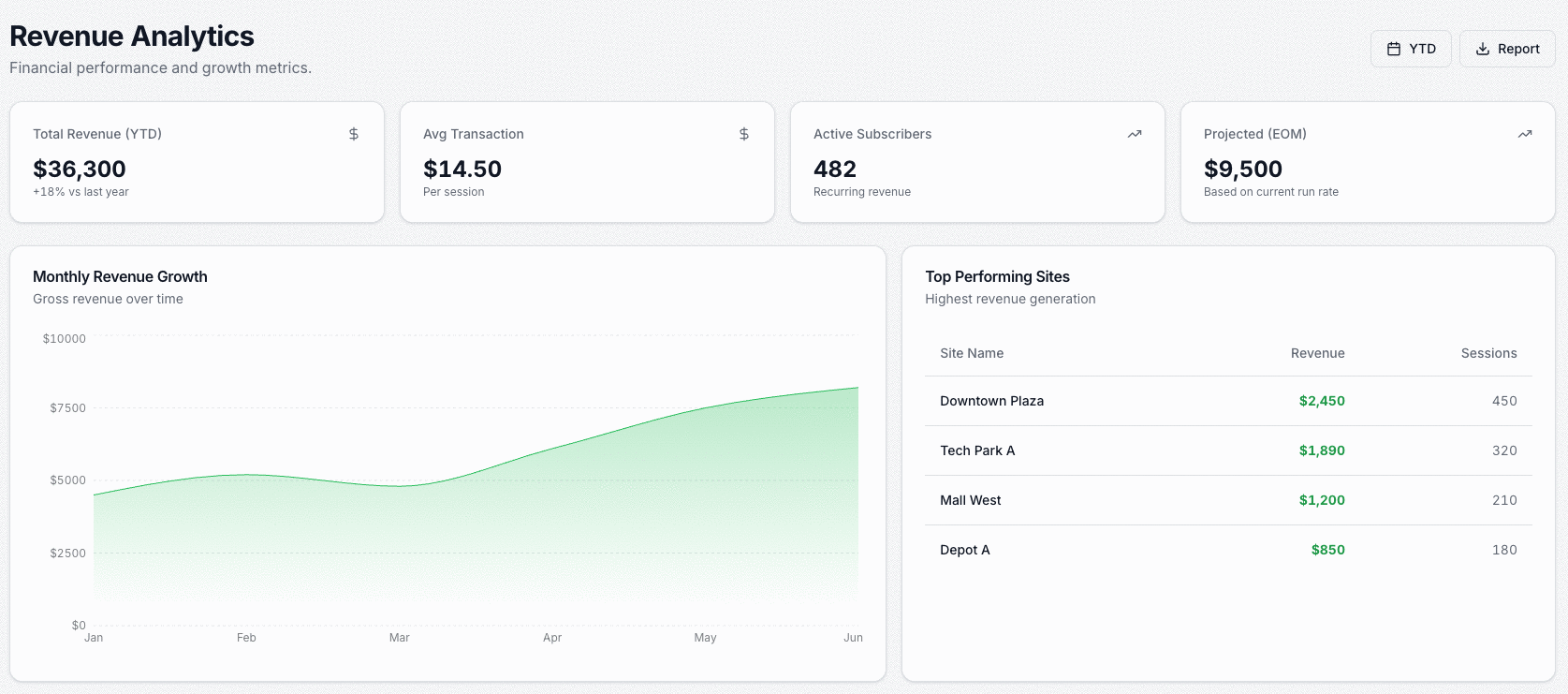
Most CPMS vendors sell you a licence, hand you a dashboard, and invoice you every month whether your business grows or not. We think that’s backwards.
Utilization and margin by site, benchmarked across your estate. We bring the analysis and a prioritized action list — not just a report.
Which sites deserve more stalls, which need a power upgrade, which should be repriced or relocated — modelled before you spend capital.
We help you set pricing against your real energy costs and local tariffs, so growth in volume doesn’t quietly erode margin.
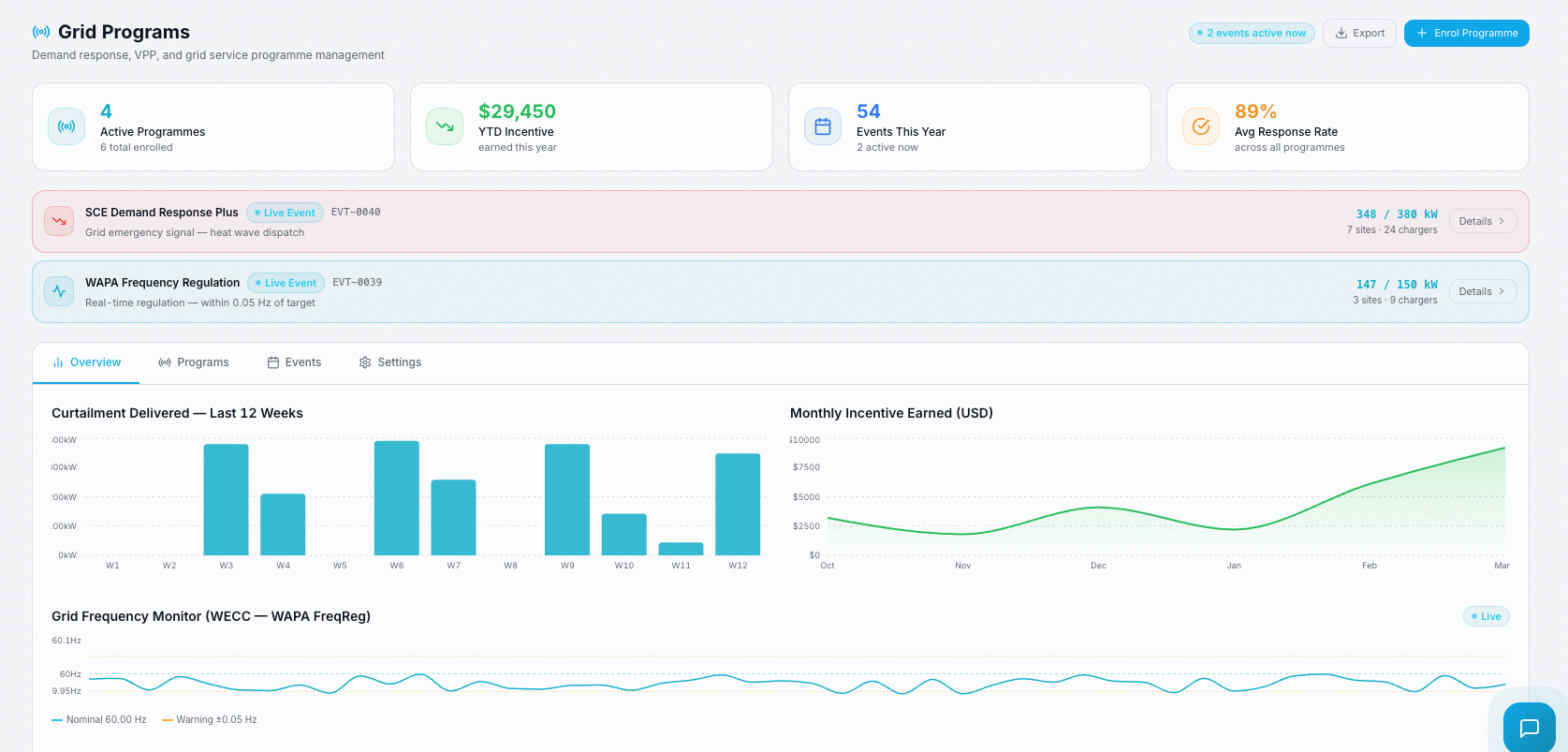
We identify and help you enrol in grid services, demand response, carbon/LCFS credit programs and roaming — then run the participation for you.
Available programs and earnings vary by market, utility and asset type. We’ll map which ones your estate qualifies for before you commit to anything.
A fleet depot has one non-negotiable: vehicles leave on time, fully charged. Everything else — cost, peak demand, capacity — should bend around that, automatically.
Charging is sequenced to each vehicle’s route and departure time, not first-come-first-served. Readiness is guaranteed first; cost is optimized around it.
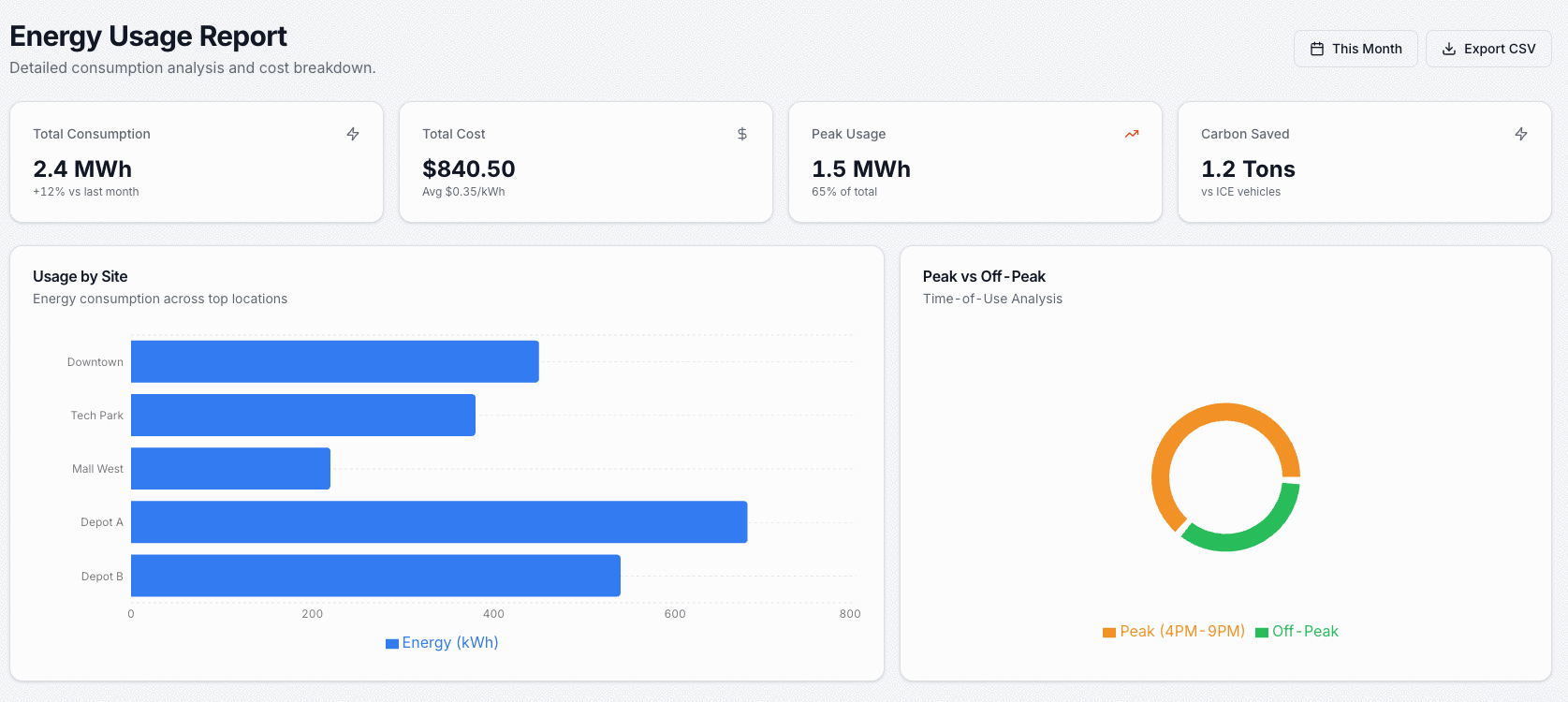
Shift charging into cheap and clean windows, hold the depot under its peak threshold, and use on-site solar or storage first where you have it.
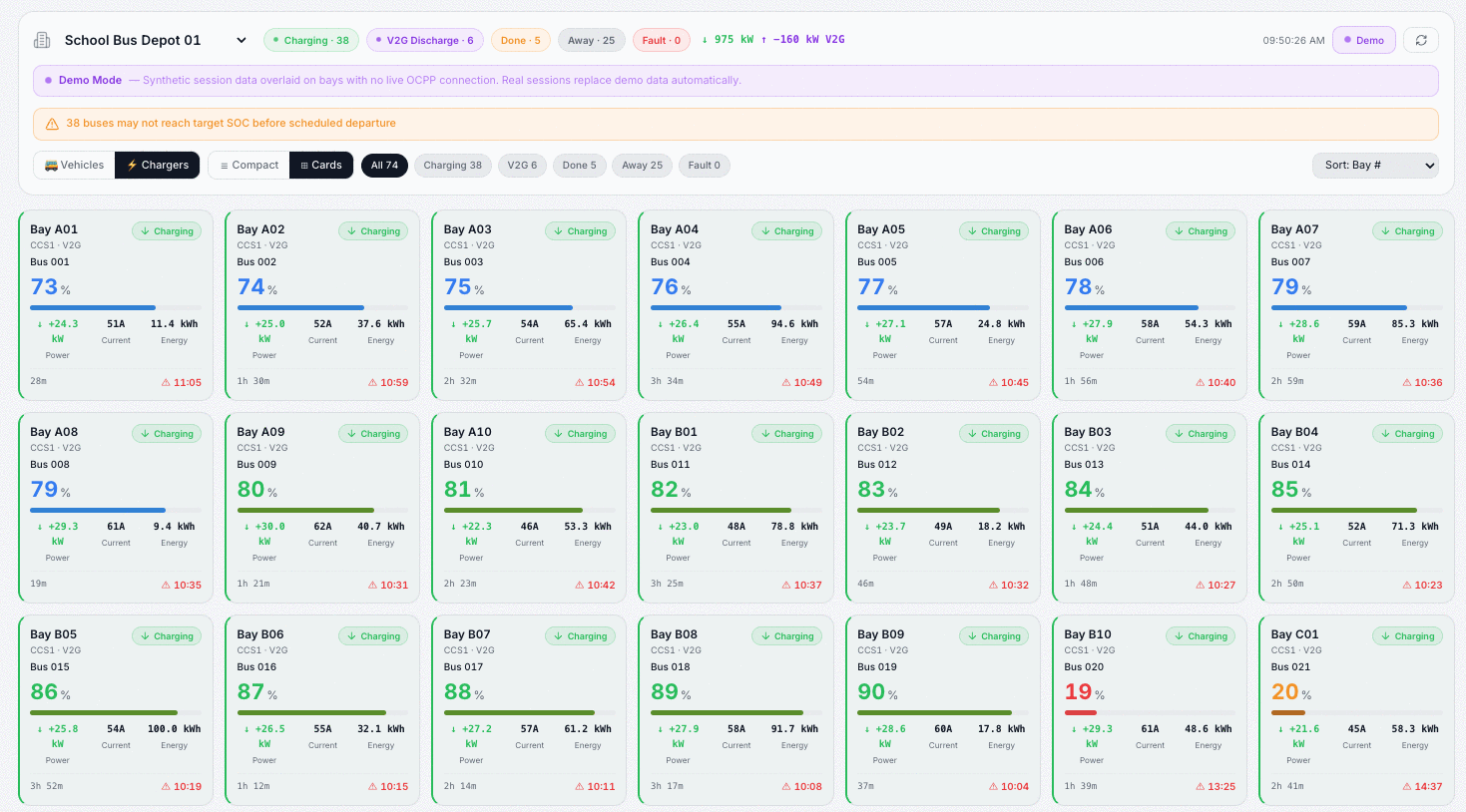
One view of vehicles, chargers and energy. Fewer manual checks, fewer surprises at 5am, and clear accountability when something isn’t ready.
Smart capacity sharing lets you add vehicles and chargers without immediately upgrading the depot’s service — the single biggest blocker to fleet electrification.
Real vehicle state of charge and schedules from your telematics provider, so decisions reflect the actual fleet, not assumptions.
Cost per mile, energy per vehicle, emissions avoided — auditable numbers for finance, sustainability teams and grant reporting.
Bidirectional charging turns fleets and driveways into grid assets. GravOS manages the whole loop — when to charge, when to export, and how never to compromise the vehicle’s actual job.
Big batteries, fixed routes, and long predictable idle windows — mid-day, overnight, weekends, and the entire summer. No other fleet is this easy to dispatch with confidence.
GravOS enforces a hard readiness floor per vehicle. Route readiness always wins — export only ever happens with energy the bus doesn’t need.
Delivery vans, transit, utility trucks and municipal vehicles all sit idle on predictable cycles. GravOS aggregates a depot into a single dispatchable resource — without ever missing a departure.
Run managed charging and V2X programs across thousands of homes: enrol customers, shift charging off peak, call export events when the grid is stressed, and measure it all for settlement.
Vehicle-to-home and vehicle-to-building backup keeps critical loads alive during outages — an easy customer benefit that drives program enrolment.
For utilities: thousands of distributed vehicle batteries become dispatchable capacity for peak shaving and local constraint relief — deferring network reinforcement.
Auditable telemetry and event records for program measurement, verification and incentive payments — the part that usually breaks pilots.
Built on ISO 15118 (including -20), OCPP 2.x, IEEE 2030.5 and OpenADR, so new bidirectional vehicles and chargers plug into programs you’ve already built.
Bidirectional capability depends on vehicle, charger and utility program support in your market. We’ll confirm what your specific assets and territory can do before you plan around it.
“I find out a charger is down when a customer complains.”
Every offline hour is lost revenue and a driver who may not return.“We send a technician for problems that turn out to be a reboot.”
Truck rolls are one of the most controllable costs in charging operations.“Our demand charges spike because everything charges at once.”
A few peak minutes a month can set a large share of the whole bill.“Our software vendor invoices us whether utilization goes up or not.”
Nobody on the other side of the contract is accountable for your growth.“The grid connection limits how many chargers we can add.”
Expansion stalls waiting on capacity you may not actually need.“We were told V2G would pay for itself. It’s still a pilot.”
Without readiness guarantees and settlement data, programs never scale.Same chargers. Same vehicles. Same sites. Different business.
Existing OCPP 1.6 / 2.x chargers across any brand and site, plus telematics, solar and storage where you have them.
Departure times, readiness floors, peak ceilings, driver experience targets. GravOS optimizes everything else around them.
The platform balances, sequences, self-heals and exports continuously. Our team reviews performance with you and plans the next move.
Six levers your finance team can model against your own bills, utilization data and local programs.
The biggest lever in public charging. Better uptime, smarter pricing and capacity where demand actually is means more sessions on the same hardware.
Model it: added sessions/stall/day × margin per session × stallsPeak charges are set by a handful of minutes each month. Capping and staggering cuts that peak without turning drivers away or delaying departures.
Model it: peak kW reduced × demand rate × 12Remote diagnosis and reset removes site visits that were never necessary — the most controllable line in an O&M budget.
Model it: avoidable visits/month × fully loaded cost per visitUsing existing electrical capacity intelligently lets you add chargers or vehicles without triggering a service upgrade or interconnection wait.
Model it: upgrade cost avoided + months of revenue pulled forwardIdle batteries sell energy and capacity back at peak. For predictable fleets like school buses, this can become a material annual line — per vehicle.
Model it: exportable kWh × vehicles × program rateDemand response, ancillary services, carbon/LCFS credits and roaming revenue — programs we help you qualify for and then run on your behalf.
Model it: enrolled kW × program rate + credits generatedWe’ll model what GravOS would have saved and earned across your sites — your tariffs, your load, your programs, your numbers. No obligation, nothing to install.
Any compliant AC or DC charger, any brand, mixed estates included.
Connect to roaming hubs and publish your stations to driver apps.
Plug & Charge, smart charging, and bidirectional V2G/V2X control.
Utility program participation, demand response and grid signals.
Real vehicle state of charge and departure schedules from your provider.
Modbus and SunSpec on site; APIs and webhooks into billing, CRM and ERP.
It means we’re accountable for outcomes, not just availability. We run a rolling growth plan with you, report against utilization and revenue, and actively enrol your assets in programs that earn. We’ll discuss commercial structures that align our incentives with your growth — talk to us about what fits your business.
That’s the design goal, and it’s what we model with you up front — savings from demand-charge reduction and avoided truck rolls, plus revenue from higher utilization, grid programs and V2G export. Whether it fully offsets the fee depends on your estate, tariffs and local programs, which is exactly what the bill analysis is for.
GravOS operates within the manufacturer’s permitted limits and your own policy — you set depth-of-discharge and cycle boundaries, and we stay inside them. Export only ever uses energy above the readiness floor you define.
Route readiness is a hard constraint, not a preference. Each vehicle has a minimum state-of-charge floor tied to its schedule; the optimizer cannot trade that away for revenue. If conditions change, charging wins.
No. GravOS works with compliant OCPP hardware you already own, and can sit across your existing systems as the intelligence layer — or replace them, whichever fits your roadmap.
GravOS Edge runs locally. Load balancing, readiness rules and safety limits keep working offline, and everything reconciles with the cloud when the connection returns.
Encryption in transit and at rest, role-based access control scoped by organization and site, and audit logging of configuration and control actions.
Usually one site or one depot as a paid pilot, with agreed success metrics. Validate the savings and revenue on your own assets, then scale across the estate.
Start with one site or one depot. Agree the metrics. Validate the savings and the revenue against your own data — then scale it.