← All products
GravOS Edge · Industrial AI Site Controller

When the network drops, your site doesn’t

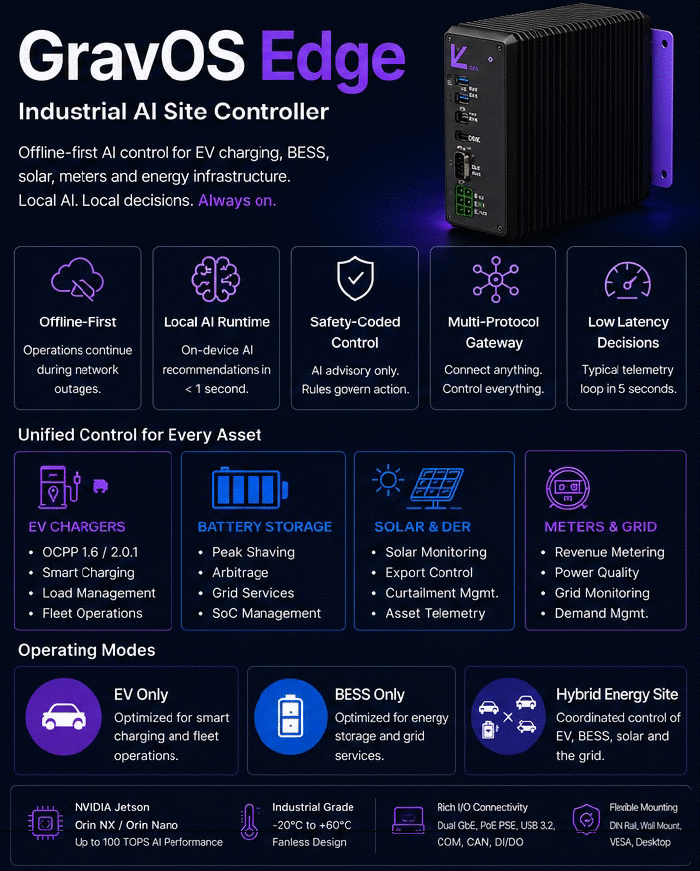
GravOS Edge runs the intelligence on site. It balances chargers, dispatches storage, follows your solar and protects your grid connection — locally, in seconds, whether or not the cloud is reachable.

Offline-first Keeps operating < 1 s Local AI decisions 5 s Telemetry loop −20…+60 °C Fanless industrial
GravOS Edge industrial AI site controller — offline-first control for EV charging, BESS, solar, meters and grid infrastructure
Why control belongs on site

Cloud-only control fails exactly when it matters

Storms, outages, cut fibre, flaky cellular at a remote depot — the moments your site most needs to behave intelligently are the moments the connection is least reliable.

Offline-first by design

Load balancing, safety limits, departure schedules and reserve floors all keep running with no internet. The site never waits on a round trip to a data centre.

Local AI runtime

Models run on the device — recommendations in under a second, against live site conditions rather than a stale cloud snapshot.

Safety-coded control

AI advises. Rules govern. Hard limits are enforced in deterministic code, so no model output can push the site past a safe boundary.

Multi-protocol gateway

Chargers, inverters, batteries, meters and controllers speaking different languages, unified into one model of your site.

Low-latency decisions

A telemetry loop measured in seconds — fast enough to protect a grid connection or hold a demand threshold in real time.

Graceful cloud sync

When the link returns, everything reconciles automatically — no lost data, no manual catch-up, no duplicated sessions.

Unified control

One controller for every asset on site

Most sites end up with a controller per vendor. GravOS Edge replaces that pile with one device that speaks to all of it.

EV Chargers

  • OCPP 1.6 / 2.0.1
  • Smart charging
  • Load management
  • Fleet operations

Battery Storage

  • Peak shaving
  • Arbitrage
  • Grid services
  • State-of-charge management

Solar & DER

  • Generation monitoring
  • Export control
  • Curtailment management
  • Asset telemetry

Meters & Grid

  • Revenue metering
  • Power quality
  • Grid monitoring
  • Demand management

Three operating modes

EV Only

Optimized for smart charging and fleet operations.

BESS Only

Optimized for energy storage and grid services.

Hybrid Energy Site

Coordinated control of EV, BESS, solar and the grid together.

Deployment

Commissioned in minutes, not site visits

A guided local setup wizard walks an installer through identity, network, remote access and cloud sync — no specialist integrator required.

1

Welcome

Power on the controller and open the local setup wizard from any laptop on the same network.

2

Network

Confirm the site network — DHCP or static, wired or cellular. Everything stays on your LAN.

3

Remote access

Enable secure outbound remote support. No inbound ports, no public IP required.

4

Cloud sync

Link the controller to your tenant and choose the operating mode — EV, BESS or hybrid.

5

Review & start

Review the configuration, start the edge stack, and the site is live and controlling assets.

Setup runs locally on the device — an installer can commission a site from a laptop on the same network, before cloud connectivity is even available.
Fleet operations

Manage one controller — or a thousand

Every deployed controller reports health, services and alerts back to one console, with remote operations so you don’t drive to a site to restart a service.

GravOS — Edge Controllers
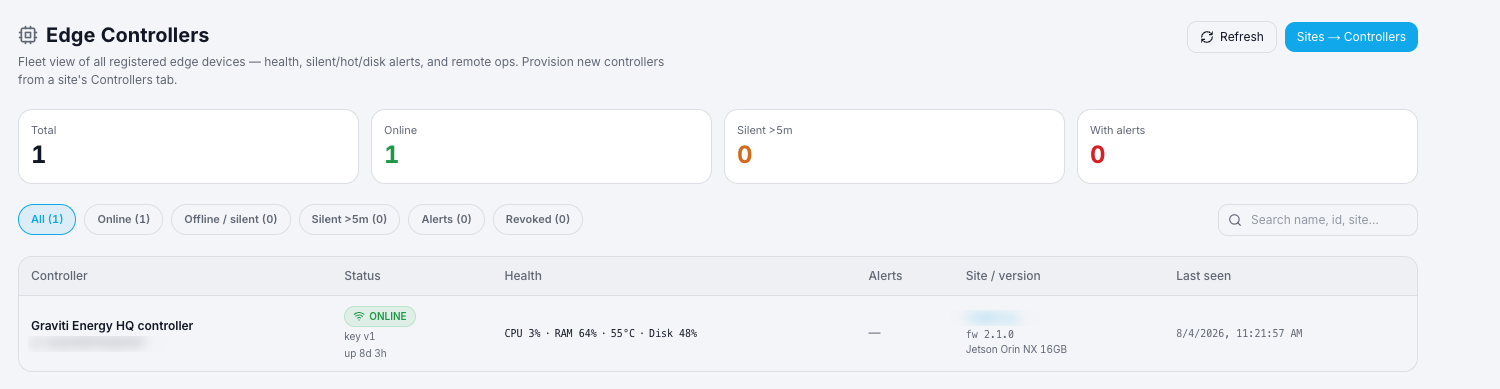
GravOS edge controller fleet view — health, alerts and last-seen status for every registered device
Fleet view of every registered controller — online status, health, alerts and firmware version at a glance.
GravOS — Controller Detail
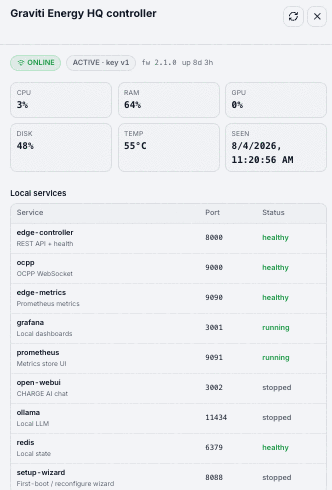
GravOS edge controller detail — CPU, RAM, temperature, running services and remote device actions
Per-device detail: CPU, memory, temperature, service health and remote actions — restart, update, upload logs.

Silent-device detection

Controllers that stop reporting are flagged automatically, so a dead site surfaces in minutes rather than at the next invoice.

Remote operations

Restart a service, push a software update or pull logs without dispatching anyone to the site.

Health telemetry

CPU, memory, disk, temperature and per-service status tracked continuously, with history for diagnosing intermittent faults.

Hardware

Built for plant rooms, not server rooms

NVIDIA Jetson Orin

Orin NX / Orin Nano — up to 100 TOPS of on-device AI performance.

Industrial grade

−20 °C to +60 °C operating range, fanless sealed design.

Rich I/O

Dual GbE, PoE PSE, USB 3.2, COM, CAN, digital in/out.

Flexible mounting

DIN rail, wall mount, VESA or desktop.

Protocols

OCPP 1.6 & 2.0.1, Modbus, SunSpec, DNP3, IEEE 2030.5, OpenADR, MQTT.

Local services

On-device metrics, dashboards, local state and an on-device LLM runtime.

Safety & security

AI advises. Rules govern.

Putting a model in charge of live electrical infrastructure is not acceptable, and we don’t do it. GravOS Edge separates intelligence from authority.

What the AI does
  • Forecasts load, generation and price
  • Proposes the best plan for the next hours
  • Detects anomalies and degradation
  • Explains its reasoning to operators
What deterministic code does
  • Enforces hard electrical and safety limits
  • Holds reserve floors and readiness thresholds
  • Rejects any command outside the safe envelope
  • Fails safe on loss of comms or sensor fault

Security posture

Encrypted transport Per-device identity & keys Role-based access Signed software updates Audit logging No inbound ports required

Remote access is outbound-initiated, so the controller doesn’t need to be exposed to the internet.

Questions we get

Deployment, networking and operations

What happens if the site loses internet for a week?

The site keeps operating. Load balancing, charging schedules, storage dispatch against local rules, safety limits and reserve floors all run on the controller. Data is buffered locally and reconciles with the cloud when connectivity returns.

Does it need inbound firewall rules or a public IP?

No. The controller initiates outbound connections only, so your IT team doesn’t need to expose it to the internet or open inbound ports.

Can the AI do something unsafe?

No — by architecture. The AI produces recommendations; deterministic, safety-coded logic decides what is actually allowed to execute. Any command outside the configured envelope is rejected regardless of what the model suggests.

Do we need one per asset type?

No. One controller handles EV chargers, storage, solar and metering together — that's the point of the hybrid mode. Larger sites can run multiple controllers for redundancy or segmentation.

Who installs it?

A qualified electrician or your usual integrator. The guided wizard runs locally on the device, so commissioning doesn’t require our team on site.

How are updates handled?

Signed software updates can be pushed remotely per device or per fleet, with staged rollout and the ability to hold a site back if it’s in a critical window.

Can we run it with our existing SCADA or EMS?

Yes. GravOS Edge can act as the intelligence and gateway layer alongside existing systems, exposing data over standard protocols and APIs.
Put intelligence on the site

Start with one controller at one site. Prove the resilience and the savings on your own infrastructure, then roll it out.