← All products Solutions · C&I Energy · Storage · VPP

A battery that sits idle is capital doing nothing

GravOS Electron turns batteries, solar and flexible load into one optimized portfolio — cutting demand charges, capturing market revenue, and giving utilities dispatchable capacity without new poles and wires. And we don’t just hand you the software: we build the revenue plan with you.

Autopilot — Optimization Engine LIVE
Riverside Industrial · 2.5 MW / 5.0 MWh · SCE TOU-8
Value captured today$1,840vs $610 baseline
Autonomous decisions1,412last 24h · 0 manual
Forecast accuracy96.2%load · 24h MAPE
Constraints respected100%warranty · reserve
Optimized 24-hour plan charge / discharge vs price
$/MWh 0003060912151821
Energy priceDischargeCharge
Why this decision explainable AI
  • Discharge 16:00–20:00Peak price forecast $102/MWh + demand-charge window. Net value after degradation: +$412.
  • Hold 20:00–22:00DR event probability 62% tonight — reserving 18% SoC for a higher-value call.
  • Charge 01:00–05:00Off-peak $26/MWh and grid carbon intensity at daily low.
  • Capped at 0.8COEM warranty limit. Revenue opportunity declined: −$38.
Decision stream 16:02:14 · Discharge 1.9 MW — peak shaving · site peak held at 3.4 MW 15:47:03 · Forecast updated — peak revised +140 kW 15:31:55 · Reserve floor enforced — export request trimmed to 1.9 MW

Autopilot builds and continuously revises a 24-hour plan for every asset — and shows you exactly why each decision was made.

Commercial & Industrial

Your peak costs more than your energy

On many commercial tariffs, a handful of minutes each month sets a large share of the bill. You don’t need to use less energy — you need to use it at different moments.

Cut demand charges

GravOS forecasts your load, sees the peak forming and discharges storage or trims flexible load before it lands — automatically, every billing period.

Arbitrage the tariff spread

Charge when power is cheap and clean, discharge when it’s expensive. The bigger your time-of-use spread, the more this earns without touching operations.

Use more of your own solar

Store midday surplus instead of exporting it at low rates, then use it when your site actually needs it. Self-consumption is usually worth far more than the export tariff.

Keep operating through outages

Reserve capacity for critical loads and island automatically when the grid fails — resilience that pays for itself the rest of the year.

One view across every site

Multi-site portfolios in a single console — compare performance, spot the underperformers and standardize what works across the estate.

Reporting that survives audit

Metered, timestamped data for ESG and sustainability reporting, incentive claims and internal finance — not spreadsheets stitched together after the fact.
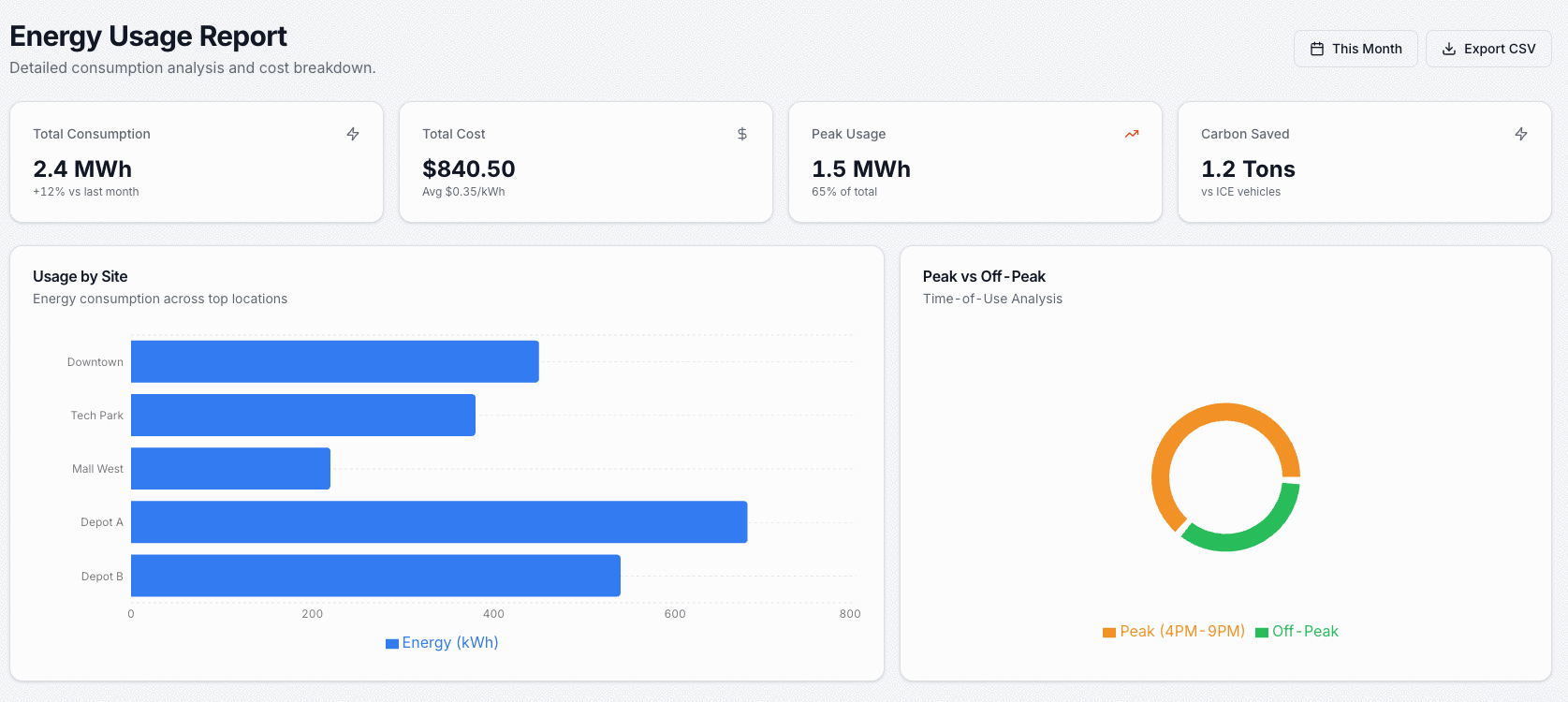
GravOS — Energy Usage Report
Consumption and cost by site with a peak vs off-peak split — where the bill actually comes from.
How we work

A battery is a capital asset. It deserves a revenue plan.

Most DERMS and EMS vendors sell you a licence and a dashboard, then invoice you monthly whether your assets earn anything or not. We think an energy asset should have someone accountable for what it returns.

The usual model
  • Licence billed monthly, regardless of asset performance
  • A control screen — the strategy is your problem
  • You find and enrol in market programs yourself
  • Dispatch logic set once at commissioning, rarely revisited
  • Fee is pure OPEX, forever
The GravOS partnership
  • We’re measured on the return your assets generate
  • A named team that reviews performance and revises strategy with you
  • We identify, qualify and help you enrol in the programs you're eligible for
  • Dispatch strategy re-optimized as tariffs, markets and load change
  • The goal: the value we unlock funds the platform

What the partnership actually includes

01

Revenue-stack design

We map every value stream your assets qualify for in your market and stack them in the right order, so one doesn’t cannibalize another.

02

Program enrolment

Demand response, capacity, ancillary services and utility programs — we handle qualification, registration and ongoing compliance.

03

Quarterly performance review

Realized savings and revenue per asset and per site, benchmarked, with a prioritized list of what to change next.

04

Portfolio growth planning

Where more storage pays back fastest, which sites to enrol next, and when adding capacity beats paying the demand charge.

Value streams we work to stack on assets you already own

Demand charge reduction Energy arbitrage Frequency response Capacity market payments Demand response events Ancillary services Solar self-consumption Grid upgrade deferral Carbon & REC value

Available programs, rates and eligibility vary by market, utility and asset type. We’ll map what your portfolio actually qualifies for before you commit to anything.

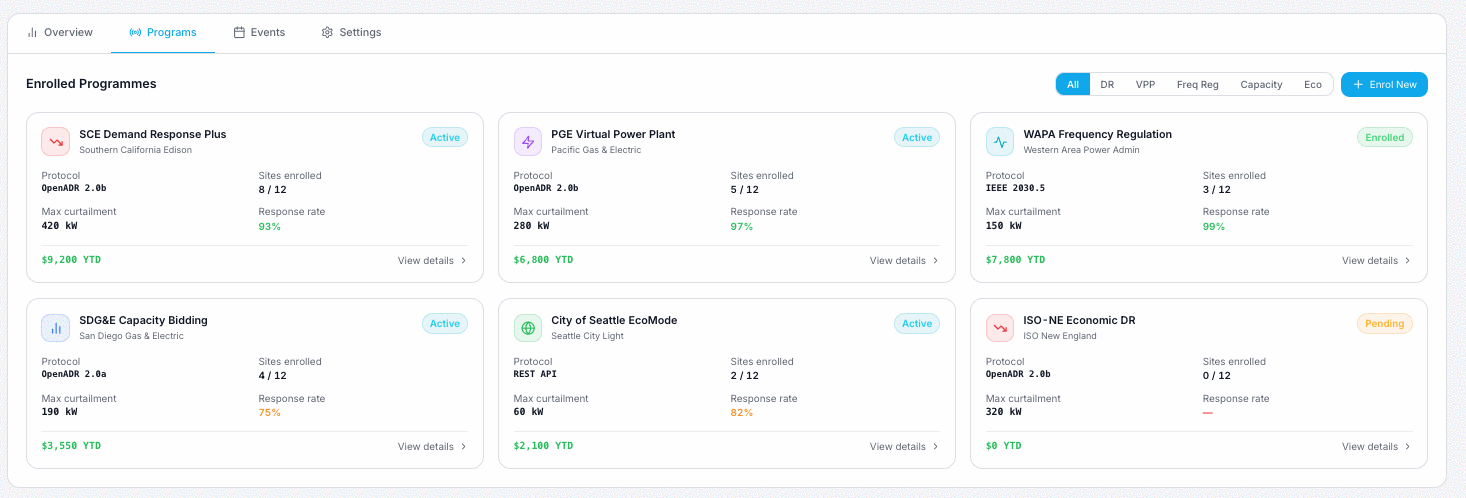
GravOS — Enrolled Programmes
Every programme your assets are enrolled in — protocol, sites, response rate and revenue earned to date.
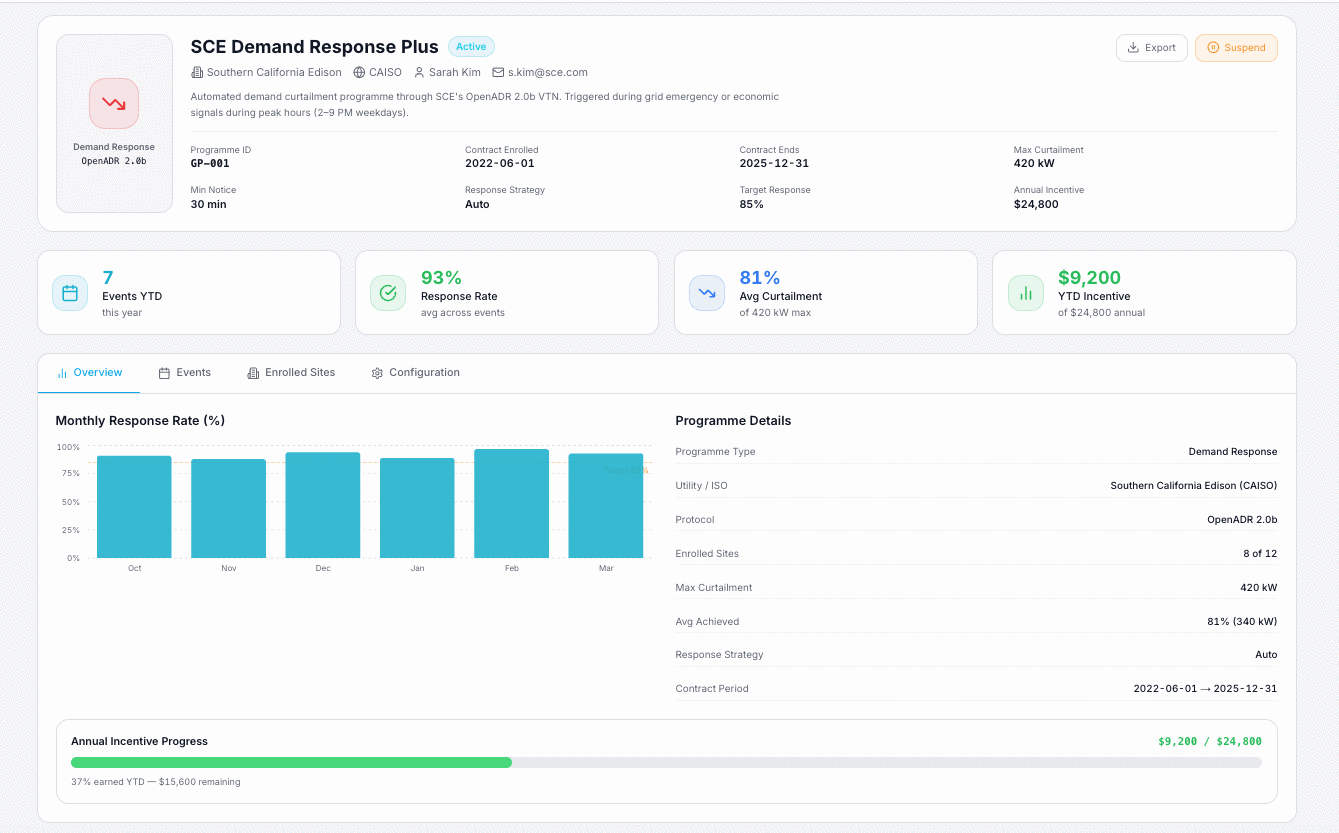
GravOS — Programme Detail
Per-programme performance: response rate, curtailment delivered and progress against the annual incentive.
Utilities & Co-ops

Capacity you can dispatch — without new poles and wires

Load is growing faster than networks can be reinforced. The flexibility already sitting behind your customers’ meters is the fastest capacity you can get.

See every DER on your network

Solar, storage, EV charging and flexible load in one operational picture — including assets you don’t own but need to plan around.

Non-wires alternatives

Relieve a constrained feeder or substation with orchestrated flexibility instead of steel, deferring or avoiding capital reinforcement.

Run customer programs at scale

Enrol thousands of residential and commercial sites into managed charging, storage and demand response — then actually dispatch them reliably.

Local constraint relief

Target dispatch to the feeder, transformer or zone that’s actually stressed, rather than blunt system-wide events.

Measurement & settlement

Auditable baselines, event performance and customer incentive settlement — the part that usually stops programs from scaling past pilot.

Standards-based interconnection

IEEE 2030.5 / CSIP, IEEE 1547 and OpenADR support, so you're aligned with interconnection rules and program requirements.

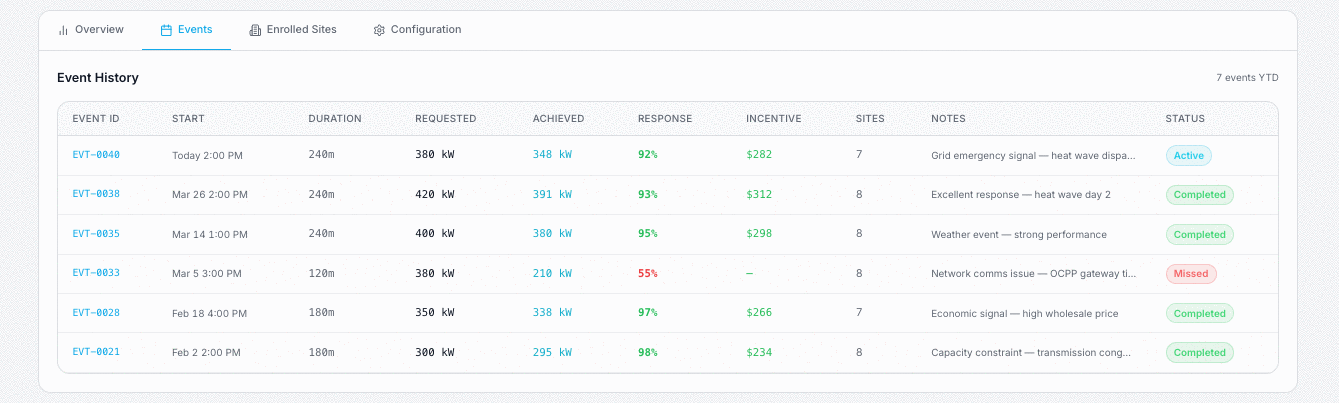
GravOS — Event History
Every event, with requested vs achieved kW, response rate and incentive — the audit trail programmes require.
Aggregators & VPP Operators

Thousands of assets. One dispatchable resource.

The hard part of a virtual power plant isn’t the idea — it’s reliable dispatch, honest telemetry and settlement that holds up when the money is real.

Aggregate mixed assets

Batteries, solar, EV chargers, HVAC and industrial load across vendors and sites, presented to the market as one controllable resource.

Bid and dispatch with confidence

Forecast available flexibility, bid what you can actually deliver, and dispatch against it — with headroom for the assets that drop out.

Telemetry that meets market rules

The measurement interval, latency and audit trail that programs demand — so performance is provable, not argued.

Multi-tenant by design

Manage portfolios across customers and programs with role-based separation, so one operator can serve many clients cleanly.

Customer-friendly participation

Respect each site’s comfort, production and readiness constraints, so customers stay enrolled instead of opting out after two events.

Grow the portfolio

Understand which asset types and sites deliver the most reliable capacity per dollar, and prioritize acquisition accordingly.

Virtual Power Plant — Operations LIVE
Portfolio: 11.6 MW dispatchable · 486 assets · 12 sites
Dispatchable now11.6 MWof 14.2 MW enrolled
Assets online471 / 48696.9% availability
Event performance97%rolling 12 events
Revenue MTD$48,320across 4 programmes
Dispatchable capacity by asset class
Battery storage4.8 MWEV charging2.6 MWSolar curtail1.9 MWHVAC / flexible load1.4 MWIndustrial process0.9 MW
Active dispatch CAISO · heat wave
94%delivered
EVT-0040 · Grid emergency Requested 4.0 MW · Delivering 3.76 MW Ends in 42 min · 7 sites · 214 assets
  • Battery firstLowest cost per kW delivered — 2.4 MW dispatched.
  • EV charging trimmed0.9 MW curtailed, all departures still met.
  • 3 sites excludedCustomer comfort limits and one maintenance window.
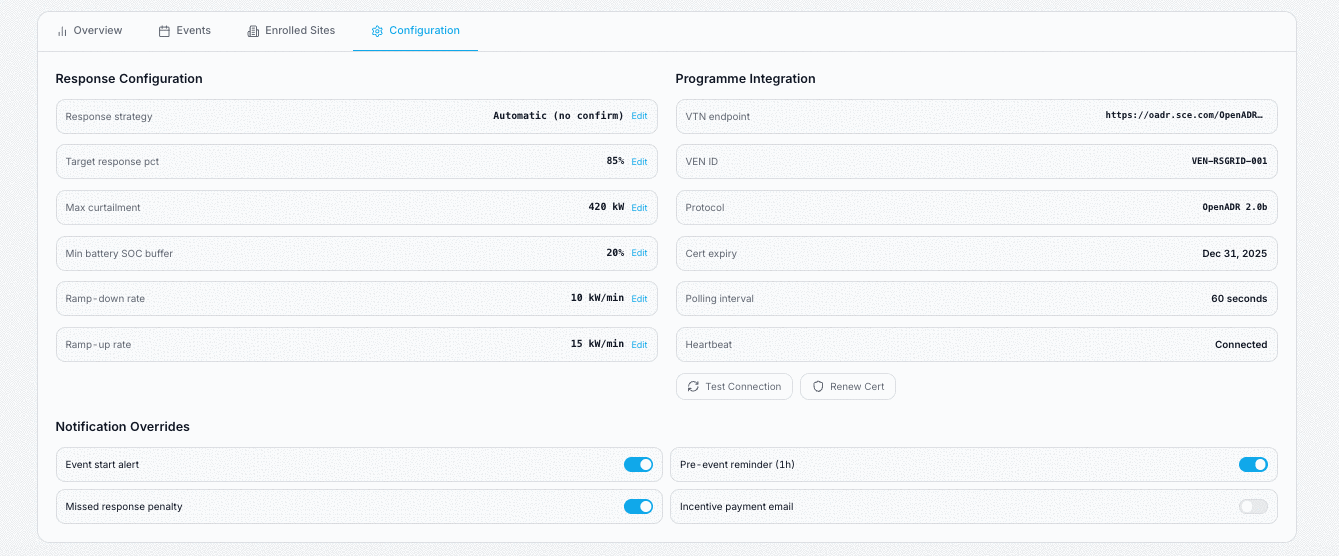
GravOS — Programme Configuration
Response strategy, curtailment limits, battery SoC buffer and VTN integration — configured per programme.
Degradation-aware dispatch

Revenue that doesn’t cost you the asset

Chasing every market opportunity can quietly consume the battery you paid for. GravOS optimizes value net of degradation — and never trades away the reserve your site depends on.

Built-in guardrails

Every dispatch decision respects the asset and the site

An optimizer that only maximizes revenue will happily cycle your battery to death or leave you without backup on the wrong afternoon. Ours doesn’t get to make that trade.

  • Warranty-aware limits — depth of discharge, cycle counts and throughput stay inside the boundaries you and your OEM set.
  • Value net of degradation — a cycle is only taken when the revenue clearly exceeds the wear it costs.
  • Resilience reserve — a protected state-of-charge floor for critical loads that market revenue can never dip into.
  • Thermal & state-of-health awareness — dispatch adapts as the asset ages and conditions change.
  • Full auditability — every decision is logged and explainable, for OEM warranty claims and internal review.

You set the constraints. GravOS optimizes inside them — never around them.

ChargeCheap, clean windows
ServeSite load & peak shaving
EarnMarket & program dispatch
ReserveProtected backup floor
One asset, four jobs — sequenced automatically, every day.
BESS Fleet — Asset Management LIVE
5 sites · 62.5 MWh installed · 24.0 MW rated
Available capacity51.8 MWh82.9% of installed
Fleet avg SoH94.3%−1.2% trailing 12m
Throughput MTD3,410 MWh1,240 equiv. cycles
Open alarms31 thermal · 2 comms
State of health by site warranty tracked
BESS-01 Riverside98.4%BESS-02 Fontana96.1%BESS-03 Chino94.8%BESS-04 Ontario92.3%BESS-05 Perris89.7%
≥95%90–95%<90%
Site detail — BESS-04 Ontario 12 racks
State of charge68% · 2.4 MWh usable
Cell delta18 mV · within spec
Max cell temp41.2 °C · Rack 06 flagged
Equivalent cycles1,842 of 6,000 warranty
Reserve floor20% · protected for backup
Sound familiar?

The problems we hear every week

“We bought a battery for demand charges and it does one job, badly.”

Single-purpose dispatch leaves most of the asset’s value unclaimed.

“Every site has a different inverter, meter and portal.”

No portfolio view means no comparison, no benchmark, no improvement.

“We know there are programs we qualify for. Nobody has time to chase them.”

Unclaimed revenue is the most common loss in distributed energy.

“Our VPP pilot worked. Scaling it broke settlement.”

Without provable telemetry, programs stall before they ever pay.

“We’re worried market cycling will void the warranty.”

Fear of degradation keeps profitable assets sitting idle.

“The feeder is constrained and reinforcement is years away.”

Growth stops while capital projects queue.
Before & after

What changes with GravOS Electron

Same batteries. Same solar. Same sites. Different return.

Today
With GravOS
The battery does one job — usually peak shaving
Value streams are stacked and sequenced so the asset earns all day
Peaks are discovered on the invoice
Peaks are forecast and shaved before they set the bill
Surplus solar is exported at a low rate
Surplus is stored and used when it’s worth the most
Market programs go unclaimed
We qualify, enrol and run participation on your behalf
Cycling decisions ignore battery wear
Every cycle is evaluated against degradation cost and warranty limits
Constrained feeders wait for reinforcement
Flexibility is dispatched locally to relieve the constraint now
Your platform is a monthly cost
Your platform actively works to unlock value that offsets its own fee
How it works

Three steps. No rip-and-replace.

01

Connect your assets

Batteries, inverters, meters, solar and flexible load across vendors and sites — over Modbus, SunSpec, DNP3, IEEE 2030.5 or your existing SCADA.

02

Set the constraints

Warranty limits, resilience reserve, comfort and production requirements, tariff structure and program commitments.

03

Autopilot runs it — and we grow it

GravOS forecasts, optimizes and dispatches continuously against your goals. Our team reviews the returns with you and plans the next value stream.

Works with the hardware you already own — Modbus, SunSpec, DNP3, IEC 61850, IEEE 2030.5 / CSIP, IEEE 1547 and OpenADR. Vendor-agnostic, no forklift upgrade.
The business case

Where the money actually comes from

Six levers your finance team can model against your own tariffs, load profile and local programs.

Demand charge reduction

Usually the largest and most predictable saving. Forecast the peak, discharge before it lands, and hold the site under its threshold every month.

Model it: peak kW reduced × demand rate × 12

Energy arbitrage

Buy low, use high. The wider your time-of-use spread and the more cycles you can safely take, the more this compounds across the year.

Model it: usable kWh × cycles/yr × price spread

Market & ancillary revenue

Frequency response, capacity and ancillary services pay for availability — often without discharging much energy at all.

Model it: enrolled MW × availability rate × hours

Demand response & capacity

Get paid to be available when the system is stressed, and paid again when you actually deliver during an event.

Model it: capacity payment + (event kW × event rate × events)

Solar self-consumption uplift

Every kWh you store and use yourself is worth the retail rate you avoid, not the export rate you'd have received.

Model it: shifted kWh × (retail rate − export rate)

Deferred grid investment

For utilities and large sites: orchestrated flexibility relieves a constraint now, deferring or avoiding reinforcement capital entirely.

Model it: reinforcement cost deferred × years × cost of capital

Send us 12 months of bills and interval data

We’ll model what GravOS Electron would have saved and earned across your sites — your tariffs, your load shape, your local programs. No obligation, nothing to install.

Request an analysis →
Compatibility

Built to work with what you already have

Modbus & SunSpec

Batteries, inverters and meters from any major vendor, across mixed estates.

IEEE 2030.5 / CSIP

Utility-grade DER communication and program participation.

IEEE 1547

Interconnection-aligned grid support functions and ride-through behaviour.

OpenADR 2.0 & 3.0

Automated demand response signalling with utilities and program operators.

DNP3 & IEC 61850

Utility SCADA and substation integration where operations require it.

APIs, webhooks & MQTT

Into your billing, ERP, data lake and reporting stack — or your own product.

Questions we get

Commercials, warranty, markets and IT

Will market participation void our battery warranty?

Not if dispatch respects the OEM’s limits — which is exactly what GravOS enforces. You configure depth-of-discharge, cycle and throughput boundaries, and the optimizer treats them as hard constraints. Every decision is logged, so you have an auditable record for warranty claims.

Which markets and programs do you support?

Program availability varies by region, utility and asset type. We’ll assess which value streams your specific portfolio qualifies for in your territory as part of the initial analysis, rather than promising a generic list.

What does “partner” mean commercially?

We’re accountable for the return your assets generate, not just software availability. That means designing the revenue stack, running program enrolment, and reviewing realized performance with you quarterly. We’ll discuss commercial structures that align our incentives with your returns.

Can the platform pay for itself?

That’s the design goal and what we model with you up front — demand-charge savings plus arbitrage, program and market revenue. Whether it fully offsets the fee depends on your tariffs, load shape and local programs, which is what the data analysis is for.

Do we have to replace our existing EMS or inverters?

No. GravOS Electron is vendor-agnostic and can sit above your existing controls as the optimization and orchestration layer, or replace them — whichever suits your roadmap.

What happens during a grid outage or loss of connectivity?

GravOS Edge runs locally. Islanding behaviour, reserve floors and safety limits keep working without the cloud, and everything reconciles when the connection returns.

Who takes market risk?

That depends on the structure we agree. We can operate assets under your market registration, or work with your chosen aggregator or retailer — we'll be explicit about who holds which risk before anything is signed.

How do we start?

Usually one site or a small portfolio as a paid pilot with agreed success metrics. Validate savings and revenue on your own assets, then scale.

Put your assets to work

Start with one site or a small portfolio. Agree the metrics. Validate the savings and revenue against your own data — then scale it.